Search This Blog

KCM Spirit Reviews

Showing posts with label 12 yr. Show all posts

Thursday, October 9, 2014

Review 223: Yamazaki 12 Year


Review 223
10/9/2014
Yamazaki 12 Year: 43% abv

Background: See Yamazaki, the flagship product of Japanese powerhouse distiller, Suntory. Suntory happens to be the Japanese company that owns just about everything, including your dog. Suntory also happens to produce Hakushu and Hibiki, but we’re not talking about that today. Today, we talk about the 12 Year Japanese Single Malt from Yamazaki. What makes Japanese Single Malt different from Scottish Single Malt? Where it comes from, effectively. Does that influence taste? Absolutely, it does. Welcome, then, to the pinnacle of fashionable contemporary whiskies that probably could run a Toyota Prius. You notice how I’m not writing about the barrel it was aged in, or the colorant, or any of that jazz? That’s because Suntory didn’t tell me any of that. So I had to talk about Toyotas…

Straight

Nose:  So what does Japanese whisky smell like? Well, as a Single Malt, it certainly contains a strong presence of malt, candy sweetness, and dominant vanilla as well. The fruitiness is prevalent in the nose, with honeydew melon, cherry, orange, and banana. There is also subtle pear and green apple notes contributing to nose, with hints of tartness and mild sweetness, mixed with drier flavors as well. There is a bit of oak, and even a suggestion of coconut on the nose as well. Dig a little deeper into the whisky, and you’ll find a little bit of saltiness present as well, although slight and very recessive. This nose also has a tinge of earthiness to it, not terribly noticeable, and frankly hard to describe, but at a minimum present.

Arrival: The arrival starts off with a good amount of spiciness, maltiness, and saltiness. There is a mild sweetness in the arrival, with some allspice. There is some oakiness to the whisky in the arrival. There is some sugar water sweetness as well.

Body: The body contains a significant amount of oakiness, fruitiness, and maltiness. There is a bit of banana, oak, and earthiness. There is mild amounts of orange and sugar sweetness in the body as well.
Finish: The maltiness kind of dominates the whisky in the finish. There is some saltiness, smokiness, and earthiness in the finish, which is fairly definitive. There is some black pepper to be found in the finish, with slight notes of tea leaves and tobacco.      

With Water

Nose: There is slightly more vanilla on the nose. The citrus is much more noticeable on the nose as well. There is some notes of cinnamon and apples. There is a suggestion of molasses on the nose as well.

Arrival: The arrival, after adding water, tends to show off a little bit of sugar, malt and fruit sweetness. In general, the heat in the whisky is not as dominant in the arrival, and a little bit more of the character is available to evaluate.
Body: There is a little bit of earthiness in the body, with oak, spicy heat, and the malt tends to be still very noticeable in the whisky.

Finish: In a weird fashion, there is more heat in the finish now than there was prior to the whisky without water. There isn’t as much flavor in the finish as there was before, but cinnamon heat and a little bit of alcohol burn are still present. There is still a light tobacco that shows up in the finish.

Final Comments: Well if you like Toyotas, you may also find this to be an appealing whisky. Despite this being the first serious contender in world markets for Japanese Single Malts, it doesn’t seem to be representing its comrades very well. It is not a BAD whisky from the strictest definition. It is, however, hugely underwhelming. You might hold credence in that all the rave about World Whiskies is for a reason, but KCM isn’t here to tell you about widely accepted opinions. We’re here to show you that in general, this whisky lacks in complexity, balance and quality, and doesn’t save itself with stark uniqueness either. This doesn’t mean good Japanese whiskies don’t exist. It means that if you’re planning on spending $65 on Single Malt, spend your money elsewhere.

Why you’d buy it: For better fuel economy.
                                                                                                          
Why you wouldn’t: You feel that value per dollar is an important metric, and you’re willing to wait for Japan to send over its serious contenders before you jump on the bandwagon.  


Score: 7.25/10

Sunday, January 12, 2014

Review 199: Bruichladdich 12 Year 2nd Edition


Review 199    
1/12/13
Bruichladdich 12 Year 2nd Edition: 46% abv

Background: Well, so long as we are doing Bruichladdich, we might as well move on to the next standard offering from them. First, a little more on Bruichladdich. Pronounced Brook-laddie, the name is Gaelic for “raised beach”. Bruichladdich sits on the west side of Islay, and is one of the less publicized malts of the island. You will come to expect that with Bruichladdich, you will see craft presentation. The 12 Year is no exception, with explicit writing on the bottle telling you that it is 46%, non-chill filtered, and natural color. That’s a great sign. Bruichladdich’s 12 Year old whisky is lightly peated, aged in Bourbon oak casks, and made by Master Distiller Jim McEwan. This whisky is sort of an anomaly to me, but we’ll get to that later in the review. Now, some notes!

Straight

Nose: The nose starts off in a very odd way. Despite being a bourbon barrel-aged whisky, there is something remarkably “sherried” smelling to this. Starting off with a rich smell of caramel, vanilla bean, chocolate, raisons, honey, and sweet malt, you would be convinced that this was a Sherry monster. The whisky is also distinctively floral in its aroma. The amount of fruitiness in here is incredible, with a succulent, rich aroma of berries and other juicy delights. There is a slightly acidic Champagne flavor that also coats the top of the glass. There is some smoky oak char and light peat to be enjoyed in this whisky. Sporadically, a little bit of campfire marshmellows is noticeable, sort of like a burnt sugar smell.

Arrival: The arrival is definitely thick, chocolately, and sweet. There was a front of acidity in the arrival, that transformed into a wave of sweetness. There is a very juicy, beautiful mixture of cherries, strawberries, and raspberries in the arrival. The arrival is definitely succulent.

Body: The body has the mysteriously raison-esque Sherry character to it. There is a lot of chocolate and caramel that add to a rich, thick body. The mouth-feel here is just incredible and thick. The body becomes quite acidic and salty as it leads into the finish.

Finish: The finish closes off with a mixture of tart fruits, dry maltiness, and coastal saltiness. It really closes the whisky reminding you that you’re dealing with a unique Islay. It has tart cranberry, fresh maltiness, cinnamon and pepper that help add to the complexity, not to mention slight traces of pecan. You will find most of the peatiness here as well. The salt becomes quite strong here in the finish. A bit of oak is also noticeable here. As the finish concludes, a grainy graham cracker flavor closes the whole event.

With Water

Nose: And to add to our craziness, the sherry flavor we’ve been accounting for all over comes out dominantly after adding water. Vanilla bean becomes more prevalent. It is also interesting how there is more of a raw grain flavor than before.

Arrival: The arrival has settled down substantially, with less attacking flavor. It seems that there is less complexity as well though. The sherry is still very dominant.

Body: There is a more confectionary, sugary flavor that comes through in the body. There is some tartness, but it is mostly sweetness and fruitiness.

Finish: The finish has brought out the darker flavors of chocolate and caramel, with an added subtle coffee to it. The finish has a bit less coastal flavor to it, with a good amount malt and more vegetal flavor, similar to the ten year. This still has a big, juicy fruitiness to it.

Final Comments: Back to the anomaly that I referenced earlier today. I just cannot believe that this whisky is not sherried! We have had a number of experiences with sherry barrel aged whiskies, and if I was blindfolded, I would have said it was one. None-the-less, this is a fantastic, balanced whisky, and Bruichladdich proves itself again. In general, this takes the other end of the spectrum from the 10 year, offering up succulent, delicious fruit notes to couple the Islay coastal style. This is just such an enjoyable whisky to sit down and sip on, we can’t help but swoon over it.
 
Why you’d buy it: It will put you in your happy place.

Why you wouldn’t: It doesn’t have that Islay peat style to it.

Score: 9.5/10

Tuesday, March 12, 2013

Review 150: Redbreast 12 Yr


Review 150
3/12/13
Redbreast 12 Year Pot Still: 40% abv

Background: Redbreast is another whiskey out of Ireland, but the whiskey comes from the Midleton pot stills in Cork. Now recall that in Scotch whiskey, all single malt scotch is aged in pot stills, whereas Irish whiskey can be produced in column stills which are a faster and cleaner process. This isn’t considered a great think to some, because grain whiskey (produced in column stills) tends to lack certain flavor that they strive for in Scottish distilleries. So when you see an Irish whiskey that is pot stilled, you can assume it to have a much different character than your traditional blended whiskeys you buy for $20 or so. The second thing we’d like to emphasize is that Irish whiskey uses malted and unmalted barley in production. Malted barley is taxed differently in Ireland, so the Irish found out that they could get favorable results out of a mixture of barleys by triple distilling their whiskey, instead of double distilling like is done in Scotland. This saved money and also produced a smooth, unique spirit that stood out from Scotch. Redbreast, triple distilled in pot stills, represents one of these whiskeys that checks all the boxes, although we are still frustrated with the abv being at 40%. Maybe a more craft presentation will come forth with time. 

Nose: Oaky, honey, barley, wheat, acidic white wine, graham crackers, cinnamon, floral rose notes, slight hints of rough alcohol (nail polish)
            A/W: creamy, oaky, slight solvent notes, lemon candy, grape
Arrival: Soft, grainy, vanilla, slight spice
            A/W: No significant change
Body: Vanilla, oak, spice, hot cinnamon, ginger
            A/W: Tart, citrus, sugar, rock candy, more creamy, balanced
Finish: Lemon candy, charred oak (ashy, slight roasted nuts), berry, ginger, heather honey, cinnamon, caramel
A/W: Citrus, more herbal, vegetal

Final Comments: Redbreast jumps ahead of the other Irish whiskies in the game, simply because it is a more complex alternative to the blends. It is characteristically Irish because it is a clean, fresh tasting whiskey, with that traditional Irish taste to it. You can certainly suggest that Irish whiskey is easy to spot out of a crowd, and this isn’t an exception. We struggle to see why we are paying $50-$60 for a spirit at 40% abv, but that doesn’t take a lot from the whiskey. This isn’t the most complex whiskey, and compared to a lot of Single Malt Scotches, it frankly doesn’t hold a candle to them. Still, it could be worth your consideration this holiday season.

Why you’d buy it: You want an upgrade from the basic Irish whiskey choices

Why you wouldn’t: You want something that will shake your foundation.

Score: 8.75/10

Saturday, December 8, 2012

Review 114: Glenfarclas 12 Yr


Review 114
12/8/12
Glenfarclas 12 Yr: 43% abv

Glenfarclas is a Highland Single Malt distillery, which is actually not very well known in Michigan. They provide their bottling in a practical cardboard canister that doesn’t really jump out at people when they see it, which might be its only crime against humanity. I can assure you that this whisky is worth that second look, despite the plain looking packaging. At 43% and an affordable price, Glenfarclas 12 hits the right marks. This whisky also does a great job of demonstrating that there whiskies with the influence of sherry that don’t need to be predominantly sweet. 

So on the nose, we’ll start off by saying there is that sherry. Sherry is coupled by malt, butterscotch, agave, gingerbread, caramel, sugar, vanilla, slight black pepper, rye, slight wet grass, and cream. It is a light, mellow nose that won’t jump out at you, but it does have a subtle complexity with a huge spectrum of flavors. The arrival does give you a great introduction into the Scotch, with vanilla, sherry, caramel, malt, sweet sugar, and a slight pepper bitterness. The body adds to this with butterscotch, slight floral notes, pear, pepper, vanilla, malt, spiciness, dry oak, and herbal notes, with some saltiness to it as well. After water, there is more saltiness and herbal notes to the whisky. The finish gives off sherry, raisons, caramel, malt, slight salty brininess, vanilla, pepper, pear, mint, tobacco, greens and herbs. 

There is a slight heat to the finish, but it is pleasant and not overbearing. Sot his might not necessarily sound like the longest list of tasting notes, so you might not think it’s the most complex, but in reality, the balanced blend of flavors does a great job of adding an intrinsic quality and complexity to this Scotch. As far as sherried Scotches go, this one takes the cake for uniqueness, mixing a weird herbal and tobacco flavor with sweetness. We also didn’t get the full scope of flavors, so we think there is more to this whisky than we’ve gathered. Highly recommended. 

Score: 9.0/10

Wednesday, November 21, 2012

Review 106: Old Pulteney 12 Yr


Review 106
11/21/12
Old Pulteney 12 Yr: 43% abv

This is a Single Malt Scotch, and quite a wonderful one. Sorry not to leave you in anticipation, but I didn’t want to wait. This is the most northern distillery on the main land of Scotland, which sits in Pulteneytown near Wick Bay. Ahh! That’s why they have the boat theme going on here. What does location matter in a whisky review? It turns out to be a really important thing. Coastal spirits generally take on a more salty, seawater characteristic, where valley whiskies have more of a fresh taste to them, which fresh valley water attributes too. Do you want evidence that this matters? Old Pulteney 12 Yr would shout that to you. Here is some tasting notes:

 On the nose, you get an instant, light graininess to the whisky, with malt barley right up front, some lemon-type citrus, and with our long intro about water sources foreshadowing to this, saltiness! Yes, there is salt and brininess to this, with some seaweed on the nose as well, but there is sweetness as well: sugarcane type sweetness, and a very slight hint of honeydew. There is slight spiciness, and a dry yeast on the nose well. The nose is quite complex, and feeds more in after water, adding some more sea water smell, light dry mint, and other dry herbs and fruits into the nose. When you finally try the whisky, you might be surprised at how personable it is. 

It does start salty on the arrival, but gives you the malt that you love in your Scotch, with some interesting ginger spice and seaweed. After water, you’ll find the arrival sweeter, with an addition of wheaty grain notes and a smooth palate. The body gives you a great blast of sweet barley, briny salt, even some slight peat. Interestingly, this isn’t a complex body before you put some water in it, but after, more starts to come out. You’ll get some heather honey, more malt, pepper and allspice, mint leaves, and even some light herb and spice notes as well. The finish is complex as well, with similar notes to the body, but adding some molasses, powdered sugar, hay and sherry, wheat, sweet cinnamon, peat, pepper, and a slight dryness. 

It is a medium finish, so not terribly impressive, but gives off some great notes and differences, and the introduction of sherry into the finish is really enjoyable. Overall, this is a complex and different Scotch, and we think it to be light-years ahead of other Scotches in the same price range. The saltiness shouldn’t deter you from this, as it is compelling and not overbearing. We highly recommend this, and at $40 a bottle, it should be a Single Malt staple for anybody looking for something refreshing and wonderful. At 43% and a natural looking color, this hits all the right marks. Highly recommended.

Score: 9.25/10

Sunday, November 18, 2012

Review 108: Glenmorangie Nectar D'Or 12 Yr


Review 108
11/18/12
Glenmorangie Nectar D’Or 12 Yr: 46% abv

In our third whisky of a three part evaluation of Glenmorangie, we look at the Sauternes cask-aged Scotch alternative. Sauternes is a light wine generally described by its high acidity and relative sweetness. That makes us wonder if this will play into the whisky at all (spoiler alert, it does). On the nose of this one, you’ll get honey right off the bat, sweetness associated with sugarcane, vanilla, sweet apple, and slight malt. 

The nose is soft and delicate, but after adding water becomes a little more fruity, adding pear, stronger grain, specifically barley and wheat. The arrival contains soft woodiness, vanilla, some slight white chocolate, and honey. After water, there is an addition of a lot of vanilla that starts being added as the whisky opens up. The body contains complex flavors of barley malt, tartness, lemon, slight brine and saltiness, grapes, pears, and a noted large amount of acidity, which tends to dominate the flavor. After adding water, there is a decrease of tartness. The finish tended to be the speaking point of this whisky.  There are some unique points to the finish. Interesting notes included white chocolate, light nuttiness, barley grain, tartness, salt, pear, melon, and acidic white grape. After water, the taste of vanilla, cream, and malt got bigger, and there was a very little spice to be tasted. 

In general, the character of this Malt whisky show huge reflections of the Sauternes wine that helped to shape its palate. It is mellow and light, carries the white wine flavors with acidity, and is not terribly complex. It is pretty smooth and water works well with it. There are some unique flavors involved with the whisky. 

Score: 8.25/10

Wednesday, October 31, 2012

Review 104: Glenmorangie Quinta Ruban 12 Yr


Review 104
10/31/12
Glenmorangie Quinta Ruban 12 yr: 46% abv

So we figured we had such good luck with the last one, we figured we would give it another go. Does Glenmorangie have three gems in a row? Let’s start with what Quinta Ruban is. At a nearly identical price to the Lasanta, the Quinta Ruban is a similar Malt with a different view. Instead of being aged in sherry casks, the whisky is aged in port wine casks. If you don’t know what port wine is like, then please see our Terra d’Oro review of a Zinfindel Port. So what’s the difference between the two? Let’s just compare from tasting notes. 

On the nose, there is a big malt and floral character to the spirit, along with interesting notes of red wine, wood, red grape. There is a wheatiness and light subtle vanilla to the nose. After adding water, the nose opens up and contributes a larger spiciness and sweet malt to the nose. Nothing about this is overtly complex, but we dug further. On the arrival, there is a very slight peat smoke to it which we found peculiar with Glenmorangie. There is a combination of brininess and sweetness to the arrival, but no distinctive flavors jumped out to the group. 

The body carries more definition, carrying some unique fruit flavors to go along with the malty character. There is a sweetness and dark fruit flavor to this malt. Among the flavors, one can find dark chocolate, cranberry, cinnamon, raspberry, sweet citrus notes, and strawberry. After you expose this malt to water, you’ll start to see ginger and molasses come out. Again, we were not blown away by the complexity of this malt, but it did represent some form of uniqueness. The finish was much more detailed, but represented a different side of this whisky. It came off as briny and salty in the beginning with caramel, black pepper, cinnamon, slight smokiness, strawberry, and some cabernet. With water though, we can pick up some more flavors, including the sweet molasses notes we got in the body, some hazelnut and cherry notes, and an Old Pulteney-esque saltiness, which has a mixture of refreshing and dry impressions to it. And just to mix it up, we even caught some slight notes of bubblegum. 

The group had a couple of comments to make about this malt. For starters, the malt took on a lot of different characters, with some spiciness, salt, hotness, and dark fruity berries to it. The group described the malt as being unsorted and confused, like it was having an identity crisis and didn’t know who it wanted to be. Although there was a large discussion on scoring, the group agreed that it didn’t measure up to Glenmorangie’s other statements and it’s lackluster complexity didn’t do it any favor. For a bargain malt, this would be an excellent choice, but at a price of around $65-70 a bottle, we would expect much more from it. 

Score: 7.75/10

Monday, October 29, 2012

Review 103: Glenmorangie Lasanta 12 Yr


Review 103
10/29/12
Glenmorangie Lasanta 12 Year: 46% abv

So, if you look back, Glenmorangie is a single malt Scotch distillery, and they like to tell us that they have the tallest stills in Scotland. The stills are probably not relevant to you, but let’s take a quick second to discuss why that matters. Because of the science of distillation, flux and still geometry make huge impacts on what’s in the still and how long it spends there. So what do taller stills do? Well, in Glenmorangie they generally make a lighter, more floral and sweet whisky. We can talk more about science later. Class dismissed. So this Lasanta stuff...what’s different from this and the Original Glenmorangie. Besides being 12 years instead of 10 years old, it is aged in a different cask. In fact, that cask is an Oloroso Sherry Cask. We like those casks, and we like the effect it has on whisky. So how about this one? 

Well, on the nose, you get a blend of flavors, greeted by the floral and light oak scents you would expect from Glenmorangie, but also big maltiness, grain, vanilla, honey, caramel apple, red grape and sweet, sweet sherry. Ahh! How refreshing. So then we drink. In the arrival, you’ll start to understand this whisky, with instant notes of citrus, apples, malt grain, gingerbread, and allspice. The arrival is crisp and refreshing, and after putting water in it, honey comes out. 

The body is moderate, with wheat, malt, sherry, wood flavors, honey, hay, caramel, gingerbread and allspice. Again, this is a pleasant, but easy taste. The finish is largely complex. There is malt, caramel, dry oak, sherry, raspberry, slightly tart cherry which becomes sweeter over time, and confectioner’s sugar. After adding water, the whisky softens up in general, but adds some spicy fruits and more vanilla to it. There is a bigger wheat flavor and less malt and sherry. In the finish, there is also a dark chocolate bitterness. 

Overall, we like the fact that Glenmorangie is bottling at 46%, and it pays off. This has good flavors and good balance, although complexity isn’t groundbreaking. This is a strong, solid statement. Worth a try if you like sherry-aged whiskys. 

Score: 9.0/10

Wednesday, July 11, 2012

Review 81: Glenfiddich 12 Yr


Review 81
7/11/12
Glenfiddich 12 Year: 40% abv

Glenfiddich. If you knew we were doing Scotches, you’d probably have guessed this was coming. This is one of the biggest, and well known Scotch distilleries in the World, pioneering single malt production around the WWII time period. Glenfiddich is a Speyside malt, but that’ll get delved into deeper in other reviews. Don’t want to get nerdy with the historical references, but just for the context, most companies regarded global spread of single malts was foolish, so you kind of owe Glenfiddich at least one bottle of purchase for allowing Scotch to be widely available on a global scale. 

The real question, though, is if their volume of production has influenced the quality of their spirit. What we’re reviewing today is their flagship Scotch, the 12 Year Old. Yeah, he’s the young one in the bunch, but Glenfiddich threw this Scotch in a bourbon cask and a sherry butt before bottling it. Stop your giggling! (A “butt” is a type of tall, skinny oak cask made from European Oak; it is the most commonly used type of cask for sherry wine) Now that we’ve got your immaturity under control, let’s move forward. Enough of the babbling; what does this son-of-a-gun taste like? 

Well, we started with the nose, which gives off some interesting, but limited flavors of malt, vanilla, cherry, sherried oak, and a hint of salt. We had some questions, but we feel there is a slight influence of hot cinnamon in the nose as well. The taste luckily gives you more to bite off of. The taste is sweet with molasses and vanilla, but also contributing defined spiciness of cinnamon and ginger as well. There is a tangy note which becomes more prominent with water, revealing some mix of orange and lemon. Finally, and you’ll hear this from everybody, but there is some pear, and even some apple to this whiskey. It isn’t until the finish that you’ll get a stronger sherry presence. 

Not like Macallan 12, but this definitely has a sweet hay taste in the finish, coupled with some grainy oatmeal and caramel. You still get those fruity notes that carry through, with some red apple and pear, and a nice cinnamon residual at the end. The finish is medium-long so you get to enjoy it a bit. Overall, we prefer this over Glenlivet’s 12 Year Scotch, but they’re really worlds apart. That being said, this isn’t the best Scotch out there, and you should definitely keep different ones. 

Score: 8.0/10

Tuesday, July 3, 2012

Review 80: Appleton Estate 12 Yr


Review 80
7/3/12
Appleton Estate 12 Year Extra Old: 43% abv

Appleton Estate is a one of a kind rum distillery from Jamaica. They have several different rums in their collection, including a V/X, a Reserve, a 12 year, and if you’re lucky to find them, a 21 year old and a 30 year old rum as well. The latter two are certainly not regular production. Appleton Estate ages their rum in barrels which had previously housed Jack Daniels, which tends to be a unique addition to the Appleton flavor. What we’re reviewing today is their 12 year old rum, which is very affordably priced at around $30 a bottle in Michigan. 

We don’t normally bring up prices in the reviews, because it biases things, but it is certainly a bargain in this case, no matter what light you look at it in. So let’s get into this a little bit. Are we just talking this one up, or is it really the spirit we’re talking about? On the nose, you will get a complex array of flavors, which range in spiciness and fruitiness, with some sweeter notes as well. Spiciness includes cinnamon, ginger and nutmeg, giving a nice balanced complexity of spices. The nose is rich and smells syrupy, but has a surprising burn to it that you normally don’t get out of a rum. One can also pull out notes of apple, but also interestingly banana and coconut. There is a dark chocolatey note, with vanilla, caramel and molasses to add to the complexity. Overall, this nose is incredibly complex and fantastically balanced. 

This is very encouraging, so without any cliffhangers, here’s the taste. In taste, we have an apparent oakiness, where the Jack Daniels lets you know it is in the rum with a semi-subtle presence. The rum has cereal grain notes to it, like rye and wheat, but it just keeps coming. The nutmeg and ginger are evident in the body, but are joined with a fresh mint taste on the arrival. Then those classic dark tastes of rum come in, like molasses, maple and toffee. The taste is also very complex, well balanced, and provides a great amount of flavor to it. The finish stays around a while too. 

There is a long finish, and gives you more fruits! Notes like cherry, strawberry, raspberry, and raisons evolve through the taste into the finish. There is a slight bitterness, but a sweetness of powdered sugar as well. The odd note in the finish is a subtle presence of agave, generally overpowered by the more powerful cinnamon note. The mint note also revisits us from the arrival. There it is. All the things to be said about this rum. Here’s the thing: is it as great as we made it sound? The best way to describe it is that we could find no flaws in the rum. Thus, we cannot mark it down for no flaws. And there it is. 

Score: 10/10

Monday, June 25, 2012

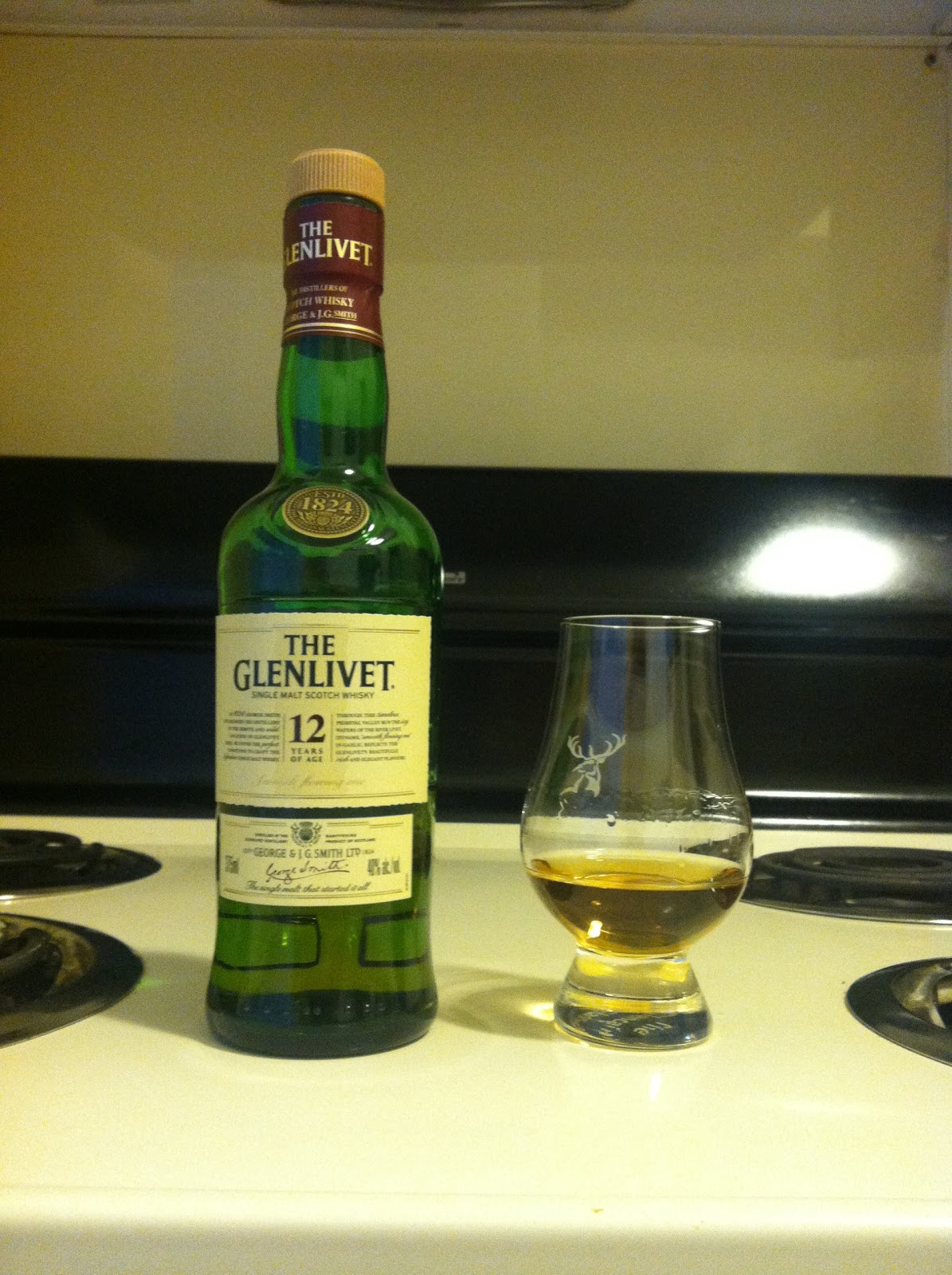
Review 70: Glenlivet 12 Yr


Review 70
6/25/12
The Glenlivet 12 Year: 40% abv

One of the classic high-runners in the world of single malt scotches. You've probably seen this one around, and if anything, it'll be at your neighborhood Applebee's. If you've never had a single malt Scotch before, this will probably be your most available option. So this is a practical choice for most people, at a reasonable price. 

On the nose, you get classic Glenlivet scents of light malt, white grapes, apple, vanilla, pear, and honey. It is not the most complex, intriguing nose as far as a Scotch goes, but it is light and refreshing. After adding water, there is slight floral notes to continue with the nose. The taste presents malt, honey, cereal grain, sweet lemon, light herbal notes on the arrival, tea leaves, and after water, some oatmeal and barley to step it up. 

In the finish, there is apple, honey, cinnamon, oatmeal, and a slight slight cherry to compliment the end of the orchestration of flavors. In general, we felt that water dulled out the flavor of this whiskey, and at 40%, it's well worth being cautious of diluting it. Not the most intriguing of Scotches, but a decent introductory to malts. 

Score: 7.5/10